
페이지 정보
high brightness screen
본문
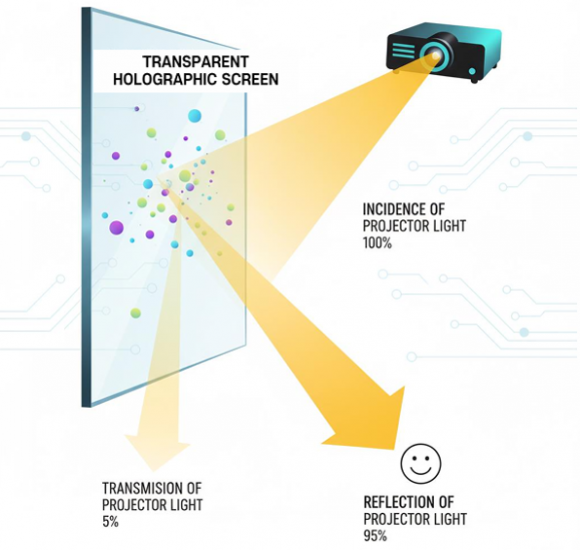
- This diagram shows how a transparent display works by utilizing the principles of light reflection and transmission.
- Incidence of Projector Light A projector emits light that strikes the transparent screen with 100% intensity.
- Reflection of Projector Light A specially treated part of the screen selectively reflects most of the light from the projector (approximately 95%). This reflected light becomes the image (text, videos, etc.) that we see on the screen.
- Transmission of Projector Light The small amount of remaining light (approximately 5%) is transmitted directly through the screen. This allows the background behind the screen to be visible, making the display appear transparent.
- In summary, this technology's core principle is to efficiently reflect light to create a clear image while simultaneously transmitting a portion of the light to maintain the screen's transparency.
Mid-to-Long-Term Scaling Strategy
<Short Term Plan>
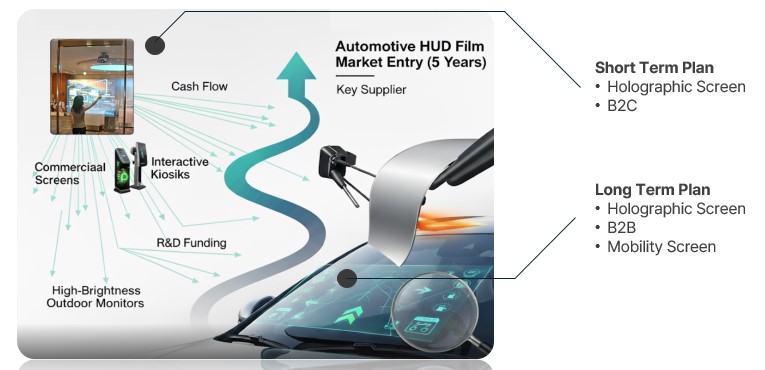
In the short term, Opticmix focuses on the B2C (Business-to-Consumer) market, leveraging its secured technology to generate essential Cash Flow and R&D Funding.
Key market entry areas include Commercial Screens, Interactive Kiosks requiring customer engagement, and High-Brightness Outdoor Monitors that demand visibility in bright external environments. The short-term goal is to build initial revenue by applying Holographic Screen technology across these relatively accessible and diverse sectors.
<Long-Term Plan>
In the long term, Opticmix will focus its efforts on the B2B (Business-to-Business) market, specifically the future mobility sector, building upon the funding and technology accumulated through its short-term plan.
The ultimate goal is to achieve Automotive HUD Film Market Entry (5 Years) within the next five years, establishing the company as a Key Supplier in the automotive field. This means commercializing its Holographic Screen technology in areas demanding high technical skill, including Mobility Screens. This is a long-term vision aimed at achieving sustainable corporate growth by targeting the stable and large-scale B2B market.
Technology Evolution and the Future of Industry
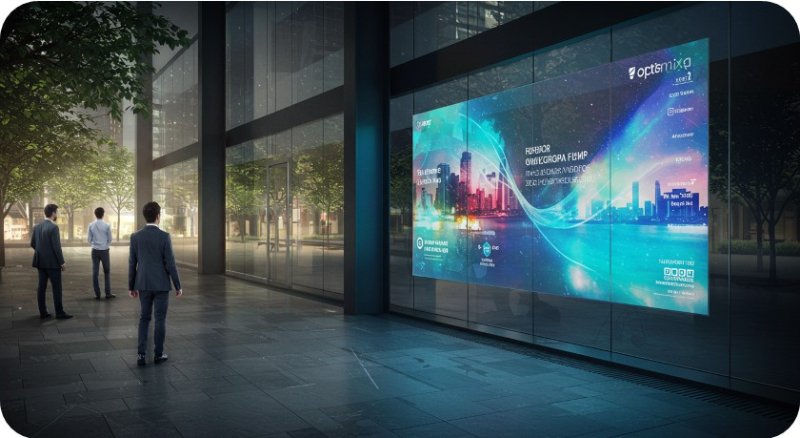
Holographic technology has the potential to innovate the efficiency and convenience of smart cities in various ways, including urban data visualization, traffic management, and the provision of public services.
● Automotive Industry
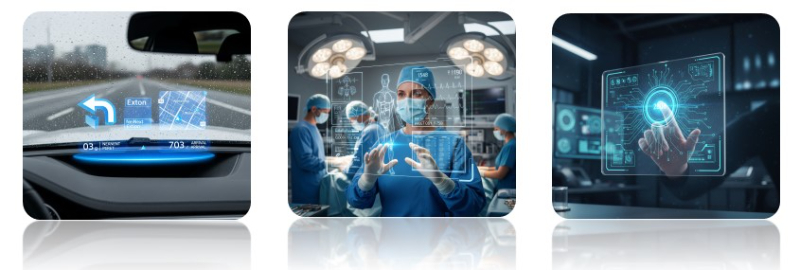
Holographic navigation displayed directly on the windshield for safer, distraction-free driving.
To minimize driver eye movement and cultivate the ultimate safe and distraction-free driving environment, essential information such as navigation, speed, and route guidance is displayed directly on the windshield in a holographic format.
This display method integrates with real world road conditions, much like Augmented Reality (AR), to provide intuitive information, positioning it as the core technology for future infotainment and safety systems.
● Medical Field
Surgeons access patient data in real-time through a contactless holographic display.
This system meets the essential requirement for medical staff to maintain sterilization in operating rooms and clean environments.
Through the contactless holographic display, the surgeon can manipulate and review core patient data such as CT/MRI images and vital signs in real time, allowing for focused concentration on the surgery.
Ultimately, this technology significantly reduces the risk of contamination and drastically enhances surgical accuracy.
● Manufacturing
Workers control machines touch-free in clean environments using holographic interfaces.
This technology is particularly useful in clean environments such as semiconductor cleanrooms or precision chemical processes, where dust and contamination must be strictly controlled.
Workers can control machinery contact-free using holographic interfaces suspended in mid-air, eliminating the need to touch physical panels or buttons.
This approach removes the risk of contamination and simultaneously increases operational efficiency and safety by providing intuitive, three-dimensional work instructions.